
Ever gotten a text that just said “IDTS“ and stared at your screen wondering what your friend actually meant? 🤔 You’re not the only one.
Texting slang moves fast, and short acronyms like this pop up everywhere — group chats, comment sections, even casual Slack messages.
This guide breaks down IDTS meaning in text completely: what it stands for, where it came from, and how to reply when it lands in your inbox. 🌟
By the end, you’ll never have to Google it again. Let’s dive in! 🚀
What Does IDTS Mean in Text & Chat? 📱
At its core, IDTS meaning in text is simple. It’s a quick way to express doubt or gentle disagreement without typing a full sentence. It’s not rude or aggressive — it’s just fast. 💨
People reach for IDTS when they:
- Doubt that a plan will actually work out 🙃
- Politely disagree with a friend’s opinion
- Want to sound casual instead of formal
- Are replying quickly on the go 🏃
Because tone in texting is invisible, the same four letters can feel playful in one chat and blunt in another. Context always shapes how the IDTS meaning in text actually lands.
Full Form, Stands For & Short Meaning of IDTS 🔤
So what does the acronym actually break down to? Here’s the quick answer for anyone skimming for a featured snippet. ✅
| Letter | Stands For |
| I | I |
| D | Don’t |
| T | Think |
| S | So |
IDTS full form: “I Don’t Think So.” 📝
It’s a short, snappy substitute for a longer sentence, built for speed-typing on phones. That’s the entire IDTS meaning in text in one line — but the way people apply it varies a lot depending on the situation.
IDTS Meaning in Medical Context 🏥
Here’s something worth clearing up: outside of texting slang, IDTS has no standard or widely recognized medical definition.
If you spot the letters in a clinical note, it’s likely a facility-specific internal abbreviation, not a universal medical term.
Always confirm with a healthcare provider rather than assuming the texting meaning applies. In everyday chats, though, the IDTS meaning in text — “I don’t think so” — is the one that matters.
IDTS Meaning in Text Urban Dictionary 📖
On slang-tracking sites and crowdsourced dictionaries, IDTS is listed consistently: an informal short form of “I don’t think so,” used to express skepticism or a soft “no.”
Some entries note it can carry a sarcastic edge depending on the emoji that follows it. 😏 That’s really the whole story behind this IDTS meaning in text entry — no hidden alternate definitions dominate these listings.
IDTS Meaning in Text Funny Interpretations 😂
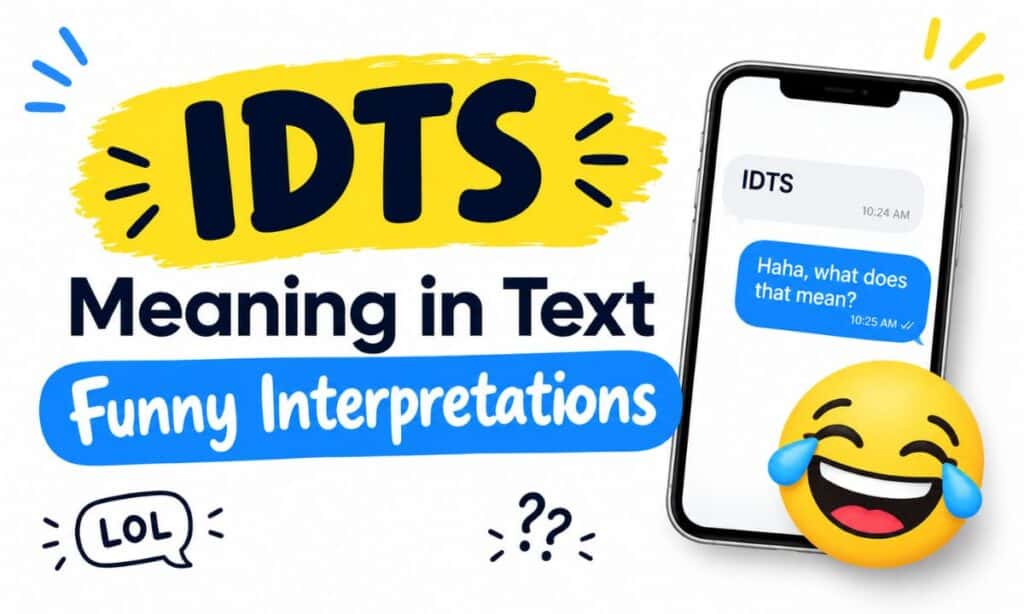
Because slang loves to be playful, people sometimes joke around with IDTS, turning it into:
- “I Definitely Think So” 🙃 (used sarcastically to mean the opposite)
- A meme caption under an obviously doubtful photo
- A humorous rejection to a silly suggestion 😅
These aren’t official meanings, just internet humor. Still, it shows how flexible the IDTS meaning in text becomes once memes get involved.
IDTS Meaning in Business 💼
There’s no official IDTS meaning in business communication. It doesn’t appear in corporate glossaries or professional shorthand. If drafting an email, skip IDTS and use full phrases instead, such as:
- “I don’t believe this is feasible.”
- “I have concerns about this approach.”
- “This may not be the right direction for us.”
Save IDTS for casual chats with coworkers you’re friendly with — never for formal documentation.
Origin, History & First Known Use of IDTS 🕰️
IDTS grew out of early SMS culture, back when phones charged by the character and every letter mattered.
📲 As texting shorthand exploded in the 2000s and 2010s, phrases got trimmed for speed — “I don’t think so” became IDTS, joining acronyms like IDK, TBH, and NGL.
There’s no single famous “first use,” but its roots trace to the character-limited texting era, later carrying over into instant messaging and social apps.
How People Use IDTS in Daily Conversations 🗣️
In everyday chats, the IDTS meaning in text appears in all kinds of low-stakes moments:
- Replying to a friend’s overly optimistic plan
- Reacting to a rumor that sounds fake
- Declining an invitation casually
- Expressing mild disbelief about news someone shared
It’s popular because it softens disagreement. Typing “no” can feel blunt, but IDTS feels more relaxed and conversational — a small buffer that keeps the mood light. 💖
IDTS Meaning Across WhatsApp, Instagram, TikTok & Snapchat 📲
The IDTS meaning in text stays consistent across platforms, though the vibe shifts slightly by app:
| Platform | Typical Use |
| Quick doubtful reply in personal chats 💬 | |
| Comment reacting to a questionable post 📸 | |
| TikTok | Caption doubting a trend or challenge 🎵 |
| Snapchat | Fast reply to a friend’s story 👻 |
No matter the app, the underlying meaning — doubt or gentle disagreement — doesn’t change. Only the tone around it does.
Different Meanings of IDTS in Other Fields 🔍
Outside texting slang, IDTS can occasionally pop up as a niche internal acronym — a project code, software label, or team-specific shorthand.
These uses aren’t standardized, so if you spot IDTS outside a casual chat, ask the sender what they meant rather than assuming the IDTS meaning in text definition applies.
Common Confusions, Mistakes & Wrong Interpretations ⚠️
A few mix-ups happen often with the IDTS meaning in text:
- Confusing it with IDK (“I don’t know”) : these mean different things entirely
- Assuming it’s always rude : tone depends heavily on context and emojis
- Reading sarcasm where none exists : plain IDTS is usually neutral
- Using it in professional emails : a common and easily avoidable mistake
Understanding the real IDTS meaning in text helps you avoid these slip-ups and interpret messages the way they were intended.
Similar Terms, Alternatives & Related Slang 🔗
Want more variety? Here are some close cousins to IDTS:
- IDK : I don’t know
- NGL : Not gonna lie
- IMO / IMHO : In my opinion
- TBH : To be honest
- Doubt it : A plainspoken alternative
These alternatives let you match the tone of a conversation precisely, whether you want to sound casual, honest, or slightly more formal.
Examples of IDTS in Real Chat Situations 💭
Seeing the IDTS meaning in text in action makes it click faster:
Friend: “I think we’ll finish the whole project tonight.”
You: “idts 😅 we still have so much left”
Friend: “Is that rumor about the concert true?”
You: “idts, sounds made up tbh”
Each example shows the same core meaning — doubt — expressed in a friendly, low-pressure way.
How to Reply When Someone Says IDTS 💡
Not sure how to respond to the IDTS meaning in text when it lands in your chat? Here are a few natural options:
- Ask for clarity: “Why not?” or “What makes you say that?”
- Agree casually: “Yeah fair, maybe not”
- Push back lightly: “Nah I actually think it’ll work”
- Add humor: “Lol okay skeptic 😂”
Since IDTS is informal, your reply can match that same relaxed tone.
Is IDTS Still Popular? Trends & Online Usage 📈
The IDTS meaning in text remains recognizable today, though it’s slightly less common than heavy-hitters like IDK or NGL.
It still shows up in group chats, comments, and casual DMs, especially among users who grew up with texting shorthand.
Digital communication keeps evolving with voice notes and GIFs, but short acronyms like IDTS haven’t disappeared — they’ve simply settled into a steady spot in everyday conversation.
Quick Facts About IDTS ⚡
- Full meaning: I Don’t Think So
- Tone: Casual and neutral
- Best used in: Texting, DMs, social comments
- Avoid in: Professional emails
- Medical/business meaning: None widely recognized
- Popularity: Still active, though less common than IDK
Conclusion 🎯
At the end of the day, the IDTS meaning in text comes down to one simple phrase: “I don’t think so.” It’s a quick, friendly way to express doubt without sounding harsh, and it works across WhatsApp, Instagram, TikTok, and Snapchat alike.
Keep it casual — skip it in business emails or medical contexts, where it simply doesn’t apply. Now that you know the full story, you can use IDTS (and reply to it) with total confidence next time it shows up in your chats. ✨
Frequently Asked Questions ❓
What does IDTS mean in text?
The IDTS meaning in text is “I Don’t Think So” — used to express doubt or mild disagreement casually.
Is IDTS rude to use?
Not typically. It’s usually a neutral or friendly way to disagree, though tone and emojis can shift its feel.
Can IDTS be used in professional emails?
No, it’s informal slang better suited for texting or social media, not formal communication.
Does IDTS have a medical or business meaning?
No, there’s no widely recognized medical or business definition beyond its texting slang use.
Is IDTS the same as IDK?
No. IDK means “I don’t know,” while IDTS means “I don’t think so” — different meanings entirely.
Where did IDTS come from?
It originated in the early SMS texting era, when short acronyms replaced longer phrases to save characters.
Is IDTS still commonly used today?
Yes, though slightly less popular than IDK or NGL, it’s still widely recognized and used casually.
